

HR teams carry significant responsibility for embedding mental health in the company in a systematic, strategic, and sustainable way.
This article provides well-founded answers to the most important questions about workplace mental health – specifically from an HR perspective. It covers everything from legal foundations and preventive measures to effective conversations, reintegration, and strategic advocacy with management.
1. What role does HR play in workplace mental health?
HR is the department responsible for a company’s most important asset: its people. Beyond recruiting, talent development, and contract management, creating a healthy and safe work environment is one of HR’s core responsibilities – and this is where mental health plays a crucial role.
HR teams act as the interface between employees and management, designers of health-promoting work structures, and often the first point of contact when employees are experiencing mental strain or seeking support.
Mental health within the workforce is a strategic lever for business success. HR shapes the conditions of work – from working-time models to leadership principles to overall company culture. Neglecting these areas can lead to psychological strain, but with proactive measures, such burdens can be prevented.
Employee mental health directly impacts key HR metrics, such as:
- employee satisfaction
- Employee Net Promoter Score (eNPS)
- number of sick days
- staff turnover
- employee retention
In addition, employers are legally required to assess psychological risks and implement appropriate measures to protect employee health.
The urgency of this topic is reflected in current data: According to a Forsa survey commissioned by KKH, sick days due to burnout have increased by 33% over the past five years. 55% of employees report feeling exhausted or burned out due to stress, and 52% say their stress levels have increased significantly over the past one to two years.
Mental health is therefore not only an individual concern but a company-wide issue – and clearly falls within HR’s responsibility.
2. What responsibilities do HR teams have for employee mental health?
HR plays a central role in workplace mental health – both from a legal and a strategic perspective. In Germany, the Occupational Health and Safety Act (ArbSchG) explicitly requires employers to protect their employees not only from physical but also from psychological risks. Section 5 of the ArbSchG states:
„A hazard may, in particular, arise from […] psychological stress at work.“
In practice, this means HR must establish structures and processes to identify psychological strain early and reduce it effectively, for example through risk assessments, workshops, or employee surveys. External partners, such as platforms like nilo, can help develop legally compliant solutions.
Day-to-day responsibilities for HR include:
- Conducting and documenting psychological risk assessments, possibly in collaboration with HSE managers
- Ensuring data privacy and confidentiality, especially for sensitive matters
- Designing training and awareness programs
- Complying with legal requirements, e.g., anti-discrimination and health-related regulations
At the same time, it’s important to recognize the limits of HR responsibility. These boundaries start where:
- the affected employee’s own responsibility comes into play
- the expertise of medical or psychological professionals is required
- the mental well-being of the HR team itself is at risk
HR teams must learn to meet their responsibilities while setting boundaries when a situation is no longer professionally or emotionally manageable alone. This means: referring employees to the appropriate experts, involving external professionals, and simultaneously safeguarding their own well-being.

3. What HR should not do regarding mental health and where to refer cases
Mental health is a sensitive area – and while HR plays a central role in addressing it, there are clear boundaries that must not be crossed. HR professionals are not medical or psychological experts and should communicate this clearly.
What HR should not do:
- No diagnoses or therapy: HR is not clinically trained and must not make diagnoses, conduct therapy sessions, or provide treatment recommendations.
- No judgment or questioning of the condition: Only medical or therapeutic professionals can assess whether a mental health condition exists – not HR or managers.
- No unlawful health questions or discrimination: Mental health conditions must never be used as criteria for hiring, promotions, or terminations. Sensitive details must not be requested or stored unlawfully.
- No overstepping in conversations: HR should never pressure employees to disclose personal information, extract intimate details, or take on a permanent counseling role.
Where HR can refer employees in case of acute mental strain:
- Company doctor or occupational health service: For questions about fitness for work, returning to the job, or necessary accommodations, the company doctor is the appropriate contact.
- External therapy or EAP services: HR can provide confidential support options (e.g., EAP programs or mental health platforms like nilo) and share contact information – but treatment is always handled by professionals.
- Health insurance or pension funds: For longer-term absences, HR can point to rehabilitation options or reintegration plans – without giving legal advice.
4. What HR professionals need to effectively improve mental health
Traditional Employee Assistance Programs (EAPs) have long been the standard solution for workplace mental health. In practice, however, they increasingly fall short. Utilization rates are often very low (1-3%), and EAPs usually come into play only after stress has already caused serious problems. By this point, it is often too late to prevent negative impacts on performance, culture, and employee retention.
What HR needs today is a holistic, preventive approach – one that is trustworthy and tailored to everyday work life. Successful solutions, such as nilo, demonstrate the key factors:
- Quality: Reliable access to qualified professionals, evidence-based methods, and consistent support ensures that interventions are effective.
- Low-threshold access: Support must be immediately available, anonymous, and digitally accessible.
- Confidentiality: Trust – and actual utilization – increase only when privacy is fully guaranteed.
- Prevention and 1:1 support: A combination of digital tools, training, and one-on-one sessions ensures employees are supported early and can access the help that meets their individual needs.
- Tailored to individual needs: Mental health offerings should fit different roles, stress levels, and needs – not every team requires the same approach.
- Ongoing support & activation: Long-term effectiveness requires more than just offering resources. Continuous communication, regular training, targeted campaigns, and customer-success support help ensure sustained usage and impact.

5. What employee benefits support mental health?
HR can draw on a wide range of benefits to actively promote mental health in the workplace. The key point: not every benefit works equally well for every group. A thoughtful mix tailored to the needs of your workforce makes the difference.
Medical and therapeutic support
- Extended health insurance covering psychotherapy, psychosomatic treatments, and inpatient care.
- Employee Assistance Programs (EAPs) offering short-term, free counseling for employees facing acute challenges.
- Occupational health services focusing on mental health and work-related stressors.
Digital mental health offerings
- Access to mental health platforms, including digital tools and content on resilience, mindfulness, or emotion regulation.
- One-on-one online sessions with psychologists – flexible and easily accessible.
- Interactive online courses on stress management, sleep, emotional regulation, and other health topics.
- Virtual group formats, such as peer-support groups, moderated roundtables, or digital self-help groups.
Working hours, recovery, and flexibility
- Mental health days: Additional days off for targeted recovery and to support psychological well-being.
- Flexible vacation and time-off arrangements: Including the option to attend therapy or medical appointments during working hours.
- Individualized work models: Flexible hours, remote work, temporary workload reduction, or task adjustments during periods of acute stress (“reasonable accommodations”).
6. How can HR professionals recognize mental strain in employees?
Mental strain is often not immediately visible – yet it can have a significant impact on well-being, performance, and team collaboration. For HR professionals, it is essential to stay attentive and notice changes early.
Typical warning signs include:
- Changes in work and performance behavior: Frequent tardiness, unexplained fluctuations in performance, difficulty meeting deadlines, or the feeling of never being able to switch off. A noticeable increase in overtime can also be a signal.
- Noticeable social behavior: Irritability, withdrawal, conflicts with colleagues, or avoiding meetings and team activities may indicate inner tension or emotional exhaustion.
- Changes in appearance: Sudden weight gain or loss, neglected personal appearance, or significant changes in clothing and self-care.
- Physical and emotional symptoms: Frequent complaints such as sleep problems, loss of appetite, back pain, headaches, or visible fatigue can also indicate psychological strain.
Important: These signs can have many different causes. HR should observe sensitively without judging – and initiate dialogue if early indicators become apparent. The earlier support is offered, the more likely it is to prevent escalation.
7. How can HR address signs of mental strain in employee or conflict conversations without stigmatizing or overstepping?
Addressing mental strain requires sensitivity – especially for HR. The goal is not to diagnose, but to create a safe space where employees can discuss next steps openly and without pressure. Key elements are clear, respectful language, voluntary sharing, and highlighting available support without forcing details.
Guidelines for HR:
- Focus on observations: Avoid assumptions or diagnoses. Describe concrete behaviors you’ve noticed, e.g.: “I’ve noticed that you’ve been withdrawing and submitting tasks late more often over the past few weeks.”
- Show a caring attitude: Make it clear that your concern is for support, not judgment: “I’m bringing this up because your health and well-being matter to me.”
- Emphasize voluntariness and respect boundaries: Encourage openness, but don’t push. The employee decides how much to share. HR does not replace therapy – the conversation stays work-focused.
- Offer concrete resources: For example, mention one-on-one sessions with psychologists via platforms like nilo, highlighting that these are completely anonymous and free for the employee.
Preparing and conducting the conversation:
Preparation:
- Create a quite, confidential setting – avoid “on-the-fly” discussions.
- Collect specific examples of noticeable changes to stay concrete and understandable.
- Clarify available support options beforehand (EAP, company doctor, external counseling, etc.)
Conversation tips:
- Start with a respectful observation:
“Lately, you seem exhausted and withdrawn – I’m bringing this up because your well-being is important to me.” - Ask open questions and listen actively:
“How do you experience your current workload?” “Is there anything you’re finding particularly difficult right now?” - De-stigmatize the topic:
“Many people go through periods where stress becomes overwhelming – this is completely normal.”
8. How should HR handle reintegration after a long-term absence due to a mental health condition?
Returning to work after a mental health-related absence is a sensitive and complex process. HR plays a key role in structuring this process in a way that is legally compliant while remaining human-centered.
If an employee has been unable to work for more than six weeks within a year, the company is required under §167 SGB IX to conduct a Betribliches Eingliederungsmanagement (BEM) – a workplace reintegration management process. This procedure is voluntary, confidential, and must not result in any disadvantages for the employee.
Otherwise, the Five-Phase Model for Reintegration is a proven technique for successful reintegration:
Phase 1: Initiating the Return
- Invite the employee to the BEM process or an individual reintegration plan – in writing, with clear notes on voluntariness and data protection.
- Identify participants (HR, managers, optionally works council, BEM team).
- Goal: Build trust and provide clarity about the process.
Phase 2: Conducting the initial meeting
- Establish a safe and confidential conversation setting.
- Clarify expectations, roles, and boundaries: What is the goal of this conversation – and what is not?
- Initial assessment: What is the employee currently capable of? What support is needed?
Phase 3: Identifying stressors and resources
- Jointly identifying work-related stressors and supportive conditions – without judgment or assigning blame.
- Involve medical assessments if needed (e.g., company doctor or treating physicians) – always with the employee’s consent.
Phase 4: Designing measures and a stepwise plan
- In collaboration with all stakeholders (employee, HR, manager, optionally physician), create an individual reintegration plan:
- Gradual increase of working hours
- Adjusted task profile
- Options for remote work
- Flexible break arrangements
- Accompanying support, such as coaching or psychological counseling
- Schedule regular check-ins to adjust workload early if under- or over-challenged.
Phase 5: Evaluation & organizational learning
- After several months, conduct a joint evaluation: What worked well? What was challenging?
- Document insights to improve future processes – for example, regarding leadership, prevention, or internal communication.
9. How does team mental health affect sick leave?
Mental health and sick leave are closely connected. The higher the stress and the lower the mental resilience within a team, the more frequently – and for longer periods – employees are absent. It’s not just isolated sick days: psychological strain increasingly leads to long-term illness.
Current figures highlight the seriousness: According to an AXA study, in 2024, mental health-related absences already accounted for 27% of all sick leave in Europe. In France, mental health has become the primary cause of long-term absences.
In Germany, trends are similar (KKH data, 2024):
- 107.3 sick days per 1,000 employees were recorded due to burnout – a 33% increase compared to 2019.
- Sick leave due to burnout rose 46% to 4.2 cases per 1,000 employees.
- On average, affected employees were absent 25.7 days per burnout case – more than a month.
- Additionally, 55% of employees report feeling exhausted or burnt out under stress, and 97% feel heavily burdened at least occasionally.
Implications for HR:
- Teams with high psychological strain not only show higher absenteeism but also higher turnover, more incomplete returns after illness, and weaker employee retention.
- Early intervention, preventive measures, and health-promoting work design are crucial to reduce mental health-related absences.
- Systematic monitoring of sick leave, regular risk assessments (including psychological factors), and expanding targeted support offerings – such as EAPs, leadership training, or resilience programs – help HR act proactively.

10. How does team mental health affect employee turnover?
Mental health not only influences well-being and productivity – it is also a key factor for employee retention. Chronic stress, emotional exhaustion, and lack of support in the workplace have been shown to increase the likelihood that employees will resign or consider changing jobs.
The numbers speak for themselves:
- Burnout doubles the likelihood that an employee will leave their company within a year, according to a study published in European Economic Letters.
- 50% of full-time employees have already left a job due to mental health concerns – this number rises to 81% for Gen Z and 68% for Millennials.
- Conversely, turnover can drop by up to 60% when companies invest in mental health programs. At the same time, 85% of job applicants consider mental health offerings an important factor when choosing an employer.
Implications for HR:
Mental health is a powerful lever for employee retention. Companies that actively support employees’ mental well-being strengthen both resilience and emotional attachment to the organization. Specifically, HR should:
- Regularly include psychological factors in engagement and exit surveys.
- Train managers in mindful communication and early detection of mental strain.
- Implement preventive measures and support programs (e.g., EAPs, resilience, training, coaching).
- Identify and address early signs of disengagement or withdrawal.
11. How can HR build a mentally healthy organizational culture?
A mentally healthy workplace culture doesn’t happen by chance – it is the result of deliberate measures and clear guidelines. Here are seven key levers to foster a mentally healthy culture:
- Strengthen psychological safety: Encourage employees to give feedback, speak up about mistakes, and share concerns. Leaders should model this openness and actively invite it.
- Establish recognition and appreciation: A healthy work environment relies on acknowledgement. Train managers to regularly recognize contributions and make achievements visible.
- Promote regular, informal interaction: Formats such as check-in meetings, virtual coffee chats, or open discussion rounds foster connection and lower the barrier for employees to voice challenges early.
- Make mental health visible: Organize regular workshops, lunch-and-learns, or awareness days focused on mental health. This builds knowledge, raises awareness, and signals that the topic is taken seriously.
- Define clear guidelines and points of contact: Clearly outline how psychological strain is addressed: Who is the point of contact? What support is available? How is discrimination prevented? Such guidelines provide security for both employees and managers.
- Enable access to external support: Ensure employees have low-barrier access to professional external help, e.g., through EAPs, psychological counseling, or platforms like nilo.
- Train managers: Offer training and development programs so leaders can recognize psychological strain, communicate empathetically, and act in ways that support a healthy team culture.

12. How can HR convince management to invest in employee mental health?
To win over executives and budget holders for mental health initiatives, HR needs clear facts and strong economic arguments. The key is to position mental health as a strategic success factor – impacting productivity, risk management, and employee retention.
Demonstrate financial impact
HR can make a compelling case by quantifying the costs of mental strain and the benefits of preventive measures:
- In Germany, sick leave due to mental health issues has increased by 47% over the past ten years – and the trend is rising.
- Presenteeism – being at work but not fully productive – cause global productivity losses of around $1 trillion annually, according to the World Health Organization.
- Mental health programs can reduce turnover by up to 60% – with average replacement costs of 40-200% of annual salary per role, this represents a significant financial lever.
- Studies show that every euro invested in mental health yields a fivefold return through reduced absenteeism, high performance, and improved retention.
Clarify legal responsibility
Mental health isn’t just a matter of care – it’s also a legal obligation:
- Psychological stress is a required component of risk assessment under §5 ArbSchG.
- Failing to address mental health increases the risk of burnout, legal consequences, and reputational damage.
Position prevention as a strategic investment
Psychological strain often develops gradually and remains unnoticed until it escalates. Preventive measures address this early:
- Over 80% of affected employees do not openly discuss mental strain – preventive programs lower this barrier.
- 85% of users on the nilo platform access the service proactively, and 71% of high-stress users report measurable improvements.
Early support prevents mental health issues from escalating and ensures long-term team performance.
Highlight impact on culture and retention
A focused mental health strategy directly benefits employer branding:
- Companies with a mentally healthy culture report up to 20% higher team loyalty.
- Employees perceive mental health offerings as a genuine sign of appreciation – a clear advantage in the war for talent.
Best practices from leading companies further convince decision-makers of the value of preventive programs. Examples can be found in our case study overview.

13. How can HR professionals further their knowledge on workplace mental health?
There are now numerous ways for HR professionals to develop their expertise in mental health. A combination of formal courses, practical seminars, and ongoing self-directed learning is particularly effective.
Helpful formats and resources include:
- Seminars and online courses with an HR focus: Online courses such as “Successfully implementing mental health in the workplace” from Hauke Akademie provide practical knowledge in a short timeframe. Flexible e-learning modules allow self-paced learning on topics like stress management, resilience building, and handling psychological strain in the HR context.
- Materials from CHP/WHM: Corporate Health Promotion (CHP) and Workplace Health Management (WHM) offer checklists, guides, and best practices that can be directly applied to HR processes – for example, integrating mental health into employee conversations or designing health-promoting work conditions.
- Professional conferences & HR communities: HR conferences focused on health and resilience (e.g., in the DACH region) provide insights into current trends, new tools, and peer exchange. Digital HR communities allow direct dialogue with other professionals and access to relevant resources.
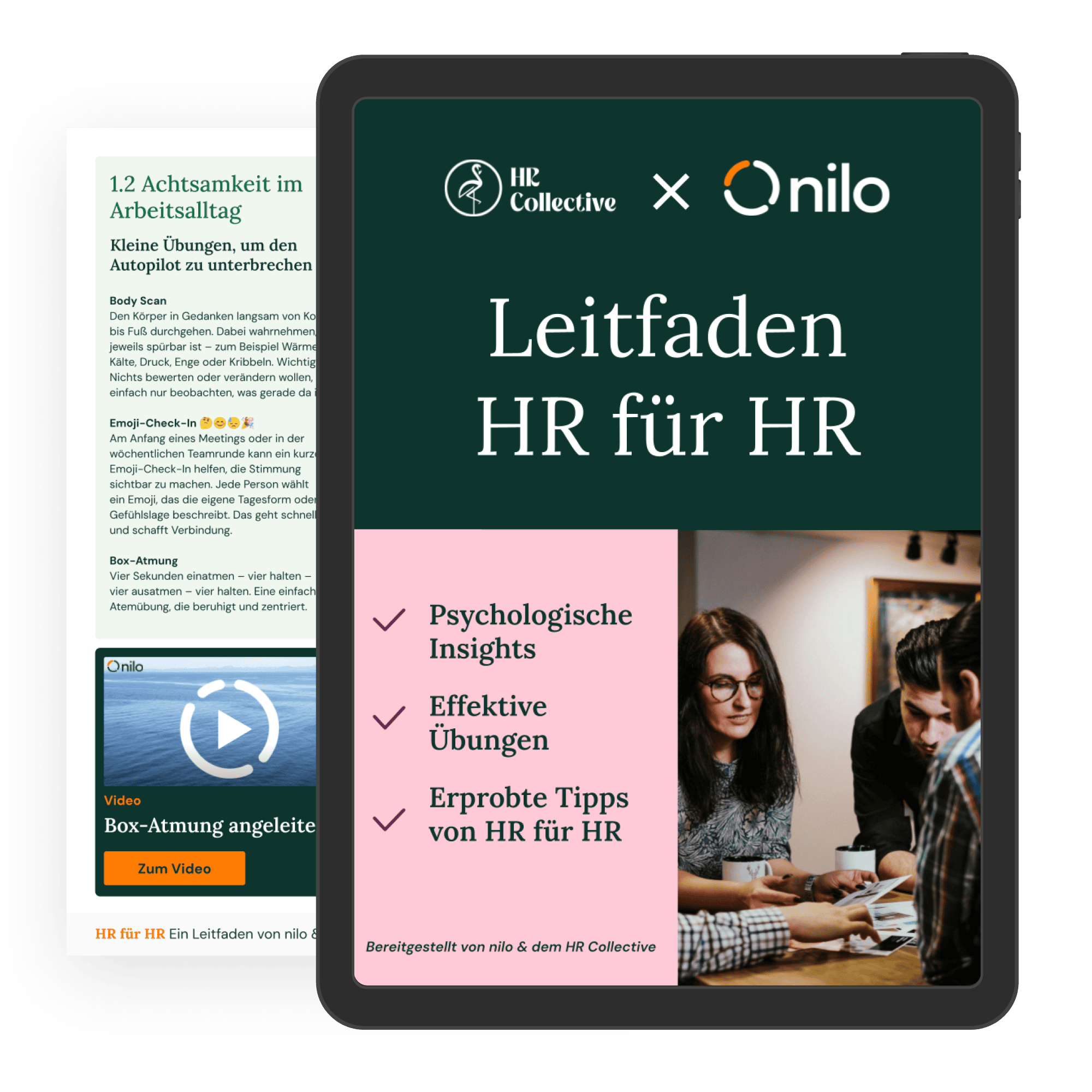
- Compact learning units from platforms like nilo: These deliver practical, everyday knowledge – for example, on how to handle conversations about overload or early recognition of psychological strain.
- Highly practical training: The Mental Health First Aid (MHFA) course offered by nilo equips HR professionals and managers to respond safely and sensitively in challenging situations.
14. How can HR professionals take care of their own mental health?
HR professionals focus on the health and well-being of others every day, but their own well-being often takes the backseat. To be effective over the long term, it’s essential to prioritize self-care. Mental health starts with taking care of yourself – and it can be strengthened deliberately, even in a fast-paced HR environment.
Here are five effective strategies:
Strengthening resilience – focus on what you can control
Not everything is in your hands, but many things are. The “Circle of Control” model helps identify what you can actively influence and what is better to let go. Setting boundaries based on this strengthens resilience and prevents burnout.
Tip: At the end of the week, reflect in writing: What was in my control? What can I let go of?
Integrate micro-breaks and mindfulness into your day
Short, conscious breaks interrupt autopilot mode and help recharge your energy. This could be a deep breath before the next call, a quick walk, or simply a moment to check in: How am I feeling right now?
Tip: Create small rituals, e.g., a quiet cup of tea, stretching after meetings, or mindful breathing between tasks.
Seek peer support and exchange
Talking with colleagues can be relieving and open new perspectives. Whether informally within the team or through HR communities, reflecting together helps.
Tip: Organize a monthly “HR Community Lunch” (online or in-person) to foster connection and mutual support.
Make self-reflection a routine
Regularly asking yourself: What feels good? What overwhelms me? is the first step toward clarity. Tools like reflection journals or scheduled reflection times help recognize patterns and take proactive steps.
Tip: Block 30 minutes per week for deliberate self-reflection – e.g., Friday mornings as a fixed “check-in with myself”.
Make your impact visible
Mental health requires resources – in the HR budget as well. Showing how HR initiatives deliver measurable impact strengthens your influence and expands your scope of action.
Tip: Develop an HR impact map that illustrates how your work contributes to business success – e.g., through reduced turnover, higher employee satisfaction, or healthier teams.