

Employee mental health and professional support in the workplace are more important than ever – and a strategic competitive factor.
At the same time, psychological pressure in the workplace is rising noticeably: according to a Forsa survey commissioned by KKH, around 55% of respondents reported feeling exhausted or burned out by the end of 2024. More than half said that stress had increased significantly over the past one to two years.
Many stress factors – such as geopolitical crises or economic pressure – are largely beyond a company’s control. But one key lever is firmly within their reach: actively strengthening employees’ resilience.
This is where psychologists in the corporate context come into play. They provide a professional framework to support employees and leaders in both professional and personal challenges, build mental resilience, and address stress early on.
What exactly does psychological support look like in a corporate setting? What formats and benefits are available – and how can companies make the most of them? This article explores these questions in detail.
Models for psychological support in companies
Psychological support for employees can be implemented in many different ways. The key is that teams and leaders have simple, confidential access to professional support – whether for acute stress or long-term prevention. The following four models have proven effective in practice:
Employer Assistance Programme (EAP)
An Employee Assistance Program (EAP) is an external service for promoting psychological health, provided by companies to their employees and leaders. EAP counseling is typically designed as short-term, immediate support and is tailored to the individual needs of the participant.
How does an EAP work?
Companies enter into a framework agreement with an external provider. Through this provider, employees and leaders gain access to professional psychological support – by phone, online, or in person, depending on the model.
A central principle is strict confidentiality: sessions are anonymous, and the employer receives no personal information about the content or participants.
Typical EAP services
Employee Assistance Programs usually offer a defined range of services, including:
- Individual psychological counseling for work-related or personal stress
- Crisis intervention in acute stress or emergency situations
- Coaching for leaders, e.g., for decision-making pressure or conflicts
- Workshops and training on stress management, communication, or conflict resolution
- Referral and support if further therapeutic help is needed
- Advice on legal, financial, or family issues
Modern EAP concepts
Modern approaches have evolved beyond the traditional EAP model. While classic EAPs mainly intervene in crises, new solutions act much earlier.
Digital platforms like nilo cover the full spectrum – from preventive psychological support to acute help. Employees get easy, low-threshold access to psychologists, can schedule appointments flexibly, and benefit from minimal waiting times.

Inhouse and corporate psychologists
In some companies, psychologists are employed directly or are regularly on-site – often as part of an Occupational Health Management or within HR.
Their responsibilities range from open counseling hours for employees to conducting psychological risk assessments, as well as advising leaders. They also design and evaluate programs to promote mental health within the organization.
Workshops, trainings, and preventive programs
Another form of psychological support comes through workshops, training sessions, and preventive programs conducted by external psychologists. These formats are often part of health days and specifically aim to improve mental health in teams. They are generally low-threshold, practical, and prevention-focused.
Typical formats include:
- Stress management training: Strategies for self-regulation and handling pressure effectively
- Resilience workshops: Strengthening psychological resistance in everyday work
- Communication and conflict training: Promoting healthy team dynamics
- Mindfulness and sleep programs: Relief through sustainable recovery and mental clarity
These offerings are often integrated into corporate health promotion and can be tailored flexibly to the needs of individual teams or leadership levels.
1:1 video sessions with external psychologists
A particularly accessible approach is through digital platforms where employees can book 1:1 sessions with professional psychologists at any time – for both work-related and personal concerns.
These sessions are fully confidential, anonymous, and location-independent. They provide not only immediate relief but also preventive support to build resilience and strengthen mental health.

What benefits do employees gain from workplace psychological counseling?
Psychological counseling within a company relieves employees and sustainably strengthens their mental health.
Improved mental health
Corporate psychological support has been shown to significantly enhance overall mental well-being. Internal evaluations indicate that 96% of nilo users report a noticeable positive effect. Early support reduces mental strain, and symptoms of anxiety or exhaustion decrease.
Building resilience and self-efficacy
External psychological support helps employees actively develop resilience. Studies on EAPs show a significant reduction in anxiety and depression among participants, indicating improved coping strategies in daily life. Individual counseling also fosters self-efficacy and a sense of personal responsibility, directly impacting quality of life and how employees handle challenges at work.
Easy access to support
Traditional therapy often involves long waiting times and logistical hurdles. Psychological counseling through external providers like nilo offers fast, confidential, and anonymous support without detours. This lowers barriers to seeking help and saves energy in already stressful situations.
Prevention and protection against overload
Early counseling can effectively prevent chronic mental illnesses and burnout. Employees can discuss early warning signs with psychologists and receive targeted guidance. Even after an absence due to mental health issues, professional support often enables a faster return to work – sometimes several weeks earlier.
Better teamwork
Psychological support positively affects team collaboration. Employees develop improved strategies for handling conflicts, uncertainties, and communication challenges. This helps prevent emotional exhaustion, reduces irritability, and promotes a healthier, more cooperative work environment.
What benefits do companies gain from providing psychological support to employees?
Only employees who are motivated, resilient, and mentally strong can consistently deliver high performance. Providing psychological support pays off for companies on several levels:
Improved corporate culture
Studies on best practices for employee well-being show that supporting mental health is a key factor in building a healthy culture and strengthening team cohesion.
Psychological support – whether through external psychologists for companies or digital mental health platforms – creates a work environment where trust, belonging, and psychological safety can grow.
Increased productivity
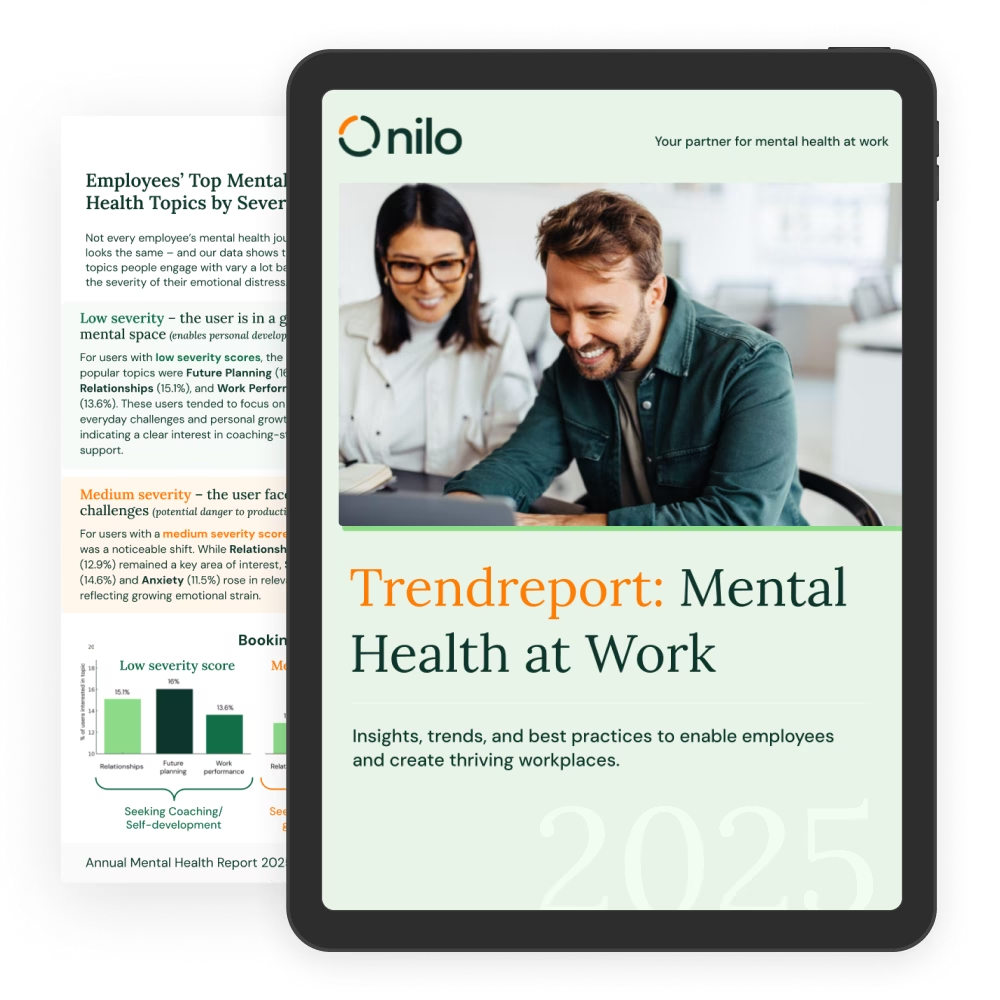
Psychological support for employees also translates into measurable performance gains. Data from the 2025 nilo Trend Report show:
- Employees engaging with psychological content reported a 15.3% increase in productivity.
- For those participating in 1:1 sessions with psychologists, the figure rose to 47.2%.
- The combination of both approached was particularly effective: 50.3% of users who accessed both content and sessions reported significant productivity gains.
Similarly, research on classical EAPs demonstrates that health-related productivity can improve significantly within just four weeks of starting counseling.
In short: Companies that make access to psychological counseling easy for their teams benefit from more focused, engaged, and high-performing employees.
Fewer sick days
Mental health challenges are among the most common causes of absenteeism – and the trend is rising. According to the AXA Mental Health Report, in 2024 already 27% of all sick leaves in Europe were due to psychological reasons.
Psychological support for employees works preventively and stabilizes performance:
- At the first signs of overload, sleep problems, or anxiety, employees receive immediate support before a sick leave becomes necessary.
- Short interventions help manage difficult situations, prioritize tasks, or address team communication issues.
- Strategies like stress management or emotion regulation have been shown to reduce the risk of sickness-related absences.
- Even after illness, structured return-to-work plans and accompanying sessions facilitate a faster and more stable reintegration – often weeks earlier than without support.
Stronger employee retention and enhances employer branding
Mental health affects not only productivity and well-being – it’s also a key driver of employee retention. Chronic stress, emotional exhaustion, and lack of support often lead employees to look elsewhere and resign.
Key figures:
- Burnout doubles the likelihood of resignation within a year, according to US studies.
- 50% of full-time employees have already quit due to mental health burdens – for Generation Z, it’s 81% and for Millennials 68%.
- Companies investing in psychological health support can reduce turnover by up to 60%.
Providing professional psychological support sends a clear signal: “Our employees’ well-being matters.” This not only strengthens emotional attachment to the company but also positively impacts employer branding.
Positive ROI
Investing in psychological support for employees also pays off economically. On average, every euro invested in mental health yields five times its value.
Psychological stress also generated high indirect costs:
- Presenteeism – reduced productivity while being physically present – causes estimated global productivity losses of around 2 trillion USD per year, according to the World Health Organization.
- Health-related issues lead to productivity losses of roughly 10-15% of work time, with the largest share attributed to presenteeism.

Psychological support with nilo: How it works
With nilo, your employees gain easy access to experienced psychologists specialized in the workplace:
- International availability: Support offered in over 50 languages and across all time zones
- Highest quality standards: Only verified psychologists with formal training and relevant professional experience
- Wide range of topics: Over 25 areas of expertise, including stress, anxiety, relationships, self-management, and leadership
- Simple online booking: An intelligent matching algorithm ensures each employee is paired with the right professional – whether for preventive support or acute challenges
FAQ – Frequently asked questions about psychological support in companies
-
How can psychologists support the mental health of employees?
-
Psychologists can strengthen workplace mental health on multiple levels – from individual counseling to systemic organizational development.
Key areas of application include:
- Advising leadership and HR: Guidance on healthy work design, self-care, change management, and psychological safety
- Individual counseling and short-term coaching: Support for stress, anxiety, specific challenges, or conflicts – often offered through EAPs or digital platforms
- Assistance with referral to long-term support: Psychological counseling can lower the initial barrier to seeking health and guide employees to further therapy or ongoing support if needed
- Support during reintegration: Development of stepwise return-to-work plans and task adjustments for stable reintegration after mental health-related absence
- Moderation during critical phases: Support in conflicts, reorganizations, or acute crises to relieve and stabilize teams
-
How does collaboration with psychologists work through nilo?
-
Employees gain easy access to psychological support via the nilo platform. They can directly book 1:1 video sessions with qualified psychologists or access a wide range of digital mental health content.
Depending on their current mental state, individual needs, and personal goals, our intelligent matching system finds the right psychologist. Our experts cover over 200 specialties and are sensitive to cultural background, diversity, and LGBTQ+ issues. Sessions are available in more than 50 languages and across all time zones – providing comprehensive support anytime, anywhere.
Our quality standards at a glance:
- Trained: Only psychologists with formal qualifications and proven expertise in evidence-based methods join our network.
- Experienced: All professionals have extensive counseling experience – on average over 5 years in 1:1 work.
- Highly rated: Sessions are rated an average of 4.9 out of 5 stars by our users.
- Specialized: From burnout, stress, and anxiety disorders to leadership, anti-racism, LGBTQ+ issues, and family dynamics – our psychologists are specialized across diverse topics.
-
What are the costs of nilo for companies?
-
The cost of nilo depends on several factors, including company size, the chosen service package, and expected usage. The starting price is 600€ per month.
We are happy to create a tailored offer that fits your specific requirements and goals.
-
Which criteria should HR consider when choosing a provider for psychological counseling?
-
When selecting a professional provider for workplace psychological support, several quality aspects are crucial:
- Qualifications of psychologists: Only highly qualified and carefully vetted professionals should be part of the program.
- Low-threshold access: A modern platform should offer flexible, easy access via desktop or mobile, with simple and timely booking.
- Variety of formats: In addition to one-on-one sessions, offerings include group discussions (e.g., roundtables), meditation programs, and digital self-guided learning modules.
- Preventive support: Services that promote resilience, self-esteem, and stress management are essential components of a comprehensive mental health benefit – not just crisis intervention.
- Data-driven insights: A dashboard with anonymized metrics provides HR with data-backed insights into team wellbeing, enabling targeted action while maintaining full confidentiality.
- Privacy and confidentiality: Strict data protection and absolute confidentiality are mandatory. Session content or personal information must never be shared with the company.
Additional selection criteria and a detailed checklist can be found here.
-
Which metrics can HR use to measure the success of psychological support in the company?
-
The effectiveness of psychological support can be assessed through a combination of health, HR, and culture-related metrics. Both quantitative data and qualitative feedback are important to evaluate the program’s impact and acceptance comprehensively.
Usage and accessibility
- Utilization rate: Percentage of employees using the support service within a given timeframe
- Waiting times: Average time until the first session
Health-related KPIs
- Psychologically-related absenteeism: Total days off, specifically for mental health-related diagnoses
- Reintegration and relapse rate: Proportion of employees successfully reintegrated versus those who experience repeated absence
- Reduction in absence duration: Comparison of average absence duration for employees who used the service versus a control group
HR and organizational metrics
- Turnover rate: Changes in voluntary resignations, especially in high-stress employee groups
- Engagement and satisfaction scores: Results from surveys on mental strain, perception of support, and leadership culture
- Presenteeism: Reduction in performance loss while present, assessed via self-reports or regular pulse surveys
- Feedback scores: Net Promoter Score (NPS), satisfaction with the support process, perceived effectiveness, and confidentiality
Financial metrics
- Costs from absenteeism and productivity loss: Indirect calculations per day absent or reduced productivity
- Return on investment (ROI): Ratio of counseling costs to savings from reduced absenteeism, lower turnover, and improved performance